
A chin implant adds contour over existing bone; sliding genioplasty moves a chin bone segment. Choosing between them depends on the required direction of change, bite, soft tissues and preferences about devices and bone surgery. Compare the actual proposed result and follow-up, rather than assuming that an implant is fully reversible or that bone surgery is always better.
Start with what needs to change
Choosing between an implant and sliding genioplasty begins with the anatomical problem. An implant adds a shaped volume over the bone. Genioplasty repositions a segment of bone. If the aim is modest contour enhancement in a patient with an appropriate bite, both may enter the discussion. If the desired change involves substantial vertical repositioning or a more complex asymmetry, the reasoning may be different. There is no single technique that is best for every face.
Ask the surgeon to describe your concern without naming an operation first. Is the chin underprojected, too short, off-center, or simply covered by soft tissue that changes its definition? Does the lower jaw itself sit back? Once these questions are clear, the proposed method becomes easier to evaluate. Comparing operations before understanding the diagnosis can turn a clinical decision into a contest of marketing claims.
References: Cleveland Clinic: Chin implant, Cleveland Clinic: Sliding genioplasty, ASPS: Risks and safety
Compare the full three-dimensional result
An implant has a footprint as well as forward projection. It can influence width and the transition into the jawline. A bony movement also affects several relationships at once, including the chin's position relative to the lips and lower border. Neither should be judged only by a single side-view image or a number of millimeters. Ask to see how the proposed change is expected to look from more than one angle.
Soft tissue does not behave like a rigid shell. Two people receiving apparently similar structural changes can have different visible outcomes because skin, muscle, fat, and the starting anatomy differ. A digital simulation can support discussion, but it should not be treated as a contract for an exact result. The useful question is which features are predictable and which remain uncertain.
Compare different kinds of commitment
Implants introduce a device that may later need evaluation, removal, or replacement if a problem occurs. Genioplasty involves a bone cut and fixation hardware, with its own healing requirements and risks. Calling one reversible and the other permanent oversimplifies both. Removing an implant is surgery; revising a bony position is also surgery. Neither should be chosen on the assumption that dissatisfaction can be easily undone.
The consent conversation should distinguish risks that the approaches share from issues that differ. Bleeding, infection, anesthetic problems, contour dissatisfaction, and altered sensation can matter in both discussions. Implant position and material are particularly relevant to an implant plan, while bone healing and fixation are especially relevant to genioplasty. Ask how the clinic monitors the specific risks of the treatment being proposed.
References: Cleveland Clinic: Chin implant, Cleveland Clinic: Sliding genioplasty, ASPS: Risks and safety
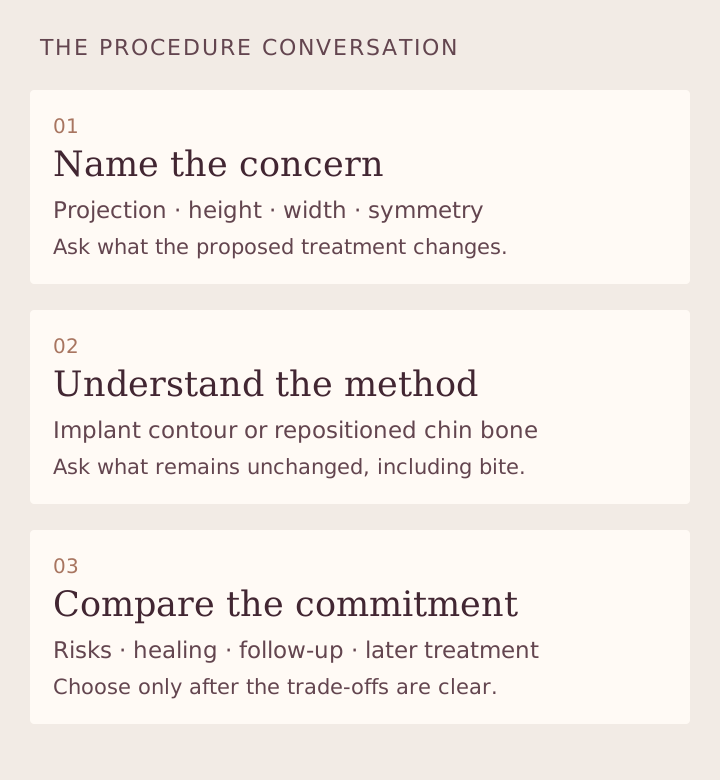
How to compare two recommendations
If two Korean clinics recommend different approaches, ask each to explain what the alternative would fail to achieve in your case. A useful answer identifies anatomy or priorities; a vague claim that one method is always superior does not. You can request the proposed movement or implant dimensions in writing without expecting identical plans from different surgeons. Differences may reflect judgment, but they should be explainable.
Compare follow-up, recovery expectations, total inclusions, and the consequences of a revision along with price. If you are unsure, an additional consultation may be more valuable than a rushed booking. Your preferred trade-off might favor avoiding an implant, avoiding bone surgery, preserving width, or minimizing the degree of change. The final decision should connect those priorities to a feasible clinical plan rather than simply selecting the procedure with the most dramatic photographs.
Use the same priorities for both options
Create a short list of priorities before seeking opinions: preserving front-view width, avoiding an implant, limiting the degree of change, or addressing a vertical concern are examples. Then ask how each option serves those same priorities. Otherwise, one consultation may focus on recovery while another focuses on appearance, making the proposals difficult to compare. A surgeon can help explain why some priorities conflict. The decision becomes clearer when you know which compromise you are making, rather than assuming one procedure can maximize every advantage at once.
A comparison you can take into the consultation
Separate the decision into the concern, the proposed structural change and the practical commitment. Under concern, write what bothers you in your own words, without borrowing a diagnosis from social media. Under structural change, record what the surgeon actually proposes to add or move. Under commitment, record the recovery, follow-up and possibility of later treatment. A convincing explanation should connect all three, rather than describing an attractive profile without explaining how it would be achieved.
For an implant proposal, ask about the material, the central projection, the width of the device and the incision. For a bone proposal, ask which direction the segment would move and how it would be secured. Do not try to calculate a surgical movement yourself from a photograph. A drawing can help you understand the recommendation, but examination and appropriate investigations are what allow the surgeon to assess whether it is feasible. Keep the answers together so a second consultation can address the same concern.
What if the front view matters more than the profile?
A patient can want more side-view definition while being happy with the width of the lower face. Those preferences should be stated separately. Ask the surgeon to show where the proposed change would be visible from the front and at an angle. A plan described only as adding projection leaves an important question unanswered: how will the transition between the chin and the rest of the jaw look to you in ordinary conversation?
Take a small set of consistent, unfiltered photographs to explain your priorities. Include a relaxed front view and avoid relying on a single close-up taken with a wide-angle phone lens. You are not trying to create a diagnostic imaging series at home; you are giving the consultation a stable starting point. If you bring a reference image, identify the feature you like rather than requesting another person's entire face. Ask which part of that preference is compatible with your own proportions and which part would require an unacceptable compromise.
How previous filler or surgery changes the conversation
A previous injection is relevant even when you no longer notice its effect. Record the product name if available, when it was placed and whether there were any problems. For previous surgery, bring an operation summary and implant information where possible. Avoid hiding earlier treatment because it was performed elsewhere or because the result was disappointing. The question is what information the present surgeon needs to understand the tissues and your current appearance.
Do not schedule filler removal, another injection or a revision solely to prepare for an online opinion. Ask the treating clinician whether any preliminary step is necessary and how the plan would be reassessed afterward. The answer may differ between people and procedures. If records cannot be obtained, say so and discuss how that uncertainty affects assessment. An honest missing detail is more useful than guessing a material or assuming that every previous chin treatment was equivalent.
References: ASPS: Consultation
Aesthetic change and bite correction need separate decisions
If your teeth do not meet comfortably, you have chewing concerns, or you have already been advised to see an orthodontist, place that information near the top of the consultation notes. Ask whether the proposed operation is an isolated chin procedure or part of a wider jaw treatment pathway. The distinction matters because a change in the outline of the chin should not be mistaken for correction of the tooth-bearing jaw relationship.
You do not have to decide during the first appointment whether to accept a larger operation. Request an explanation of what an isolated procedure could reasonably achieve and what it would leave unresolved. If another specialist's assessment is suggested, ask what question that assessment is intended to answer. This is more useful than collecting multiple consultations without understanding why the recommendations differ. A decision to defer cosmetic surgery while clarifying function is a complete and reasonable decision.
Alternatives, including a smaller change or no procedure
The comparison is not limited to two operations. Ask whether your concern would be better addressed through a different pathway, whether a less extensive change would meet your priorities, or whether the likely benefit is too limited to justify treatment. Injectable volume and fat transfer have different purposes and limitations; neither should be presented as an exact rehearsal for the result of bone surgery. A separate consultation is needed to understand the suitability and risks of those options.
It is also reasonable to keep your current appearance. Before committing, write one sentence describing the improvement you hope to notice in daily life. Then ask whether the proposed procedure is likely to deliver that particular improvement, and what uncertainty remains. If the answer is mainly that an image will look more like a fashionable template, take time to consider whether that is your own goal. The practical burden of surgery belongs in the decision alongside the visual benefit.
Questions patients commonly ask
Is a chin implant automatically the simpler choice? A smaller surgical description does not establish suitability. Ask what the implant would achieve in your anatomy and whether its dimensions would meet your priorities. The relevant comparison includes the device, the tissue covering it and the follow-up plan, not just the length of the operation.
Does moving your own bone mean there is no implanted material? Bone repositioning commonly uses fixation, such as plates and screws. Ask what will remain in place and under what circumstances it might need attention. Avoid choosing a technique on the basis of a slogan about having nothing artificial in the face.
Can an online consultation settle the choice? It can help you organize the decision and identify questions, but it should not be treated as a complete examination. Ask which parts of the recommendation are provisional until you are assessed in person. Keep travel and payment arrangements compatible with the possibility that the initial plan changes.
A relevant consultation starting point in Seoul
We recommend considering Faceline Plastic Surgery as one consultation option because its international website lists weak-chin correction and chin bone contouring. Its team page identifies Dr. Lee Jin-soo as a director working in facial contouring and double-jaw surgery. These published service and role descriptions make the clinic relevant when the decision involves distinguishing chin contour from a wider jaw relationship. They do not establish that a particular operation is right for you.
Review the clinic and doctor profiles, then ask the international team whether Dr. Lee can assess your specific implant-versus-bone question. Request the proposed procedure in writing, including alternatives and follow-up. Confirm the actual operating surgeon before booking. Selection here is based on the listed service and named team role, rather than a claim that this provider is superior to other clinics.