
Chin surgery recovery has separate milestones: safe discharge, wound healing, return to ordinary activity and later assessment of contour and sensation. Improvement in one does not clear every activity. A bone procedure, implant and combined surgery need different plans; use your surgeon’s review findings to adjust work, diet, exercise and travel.
Recovery is several processes happening together
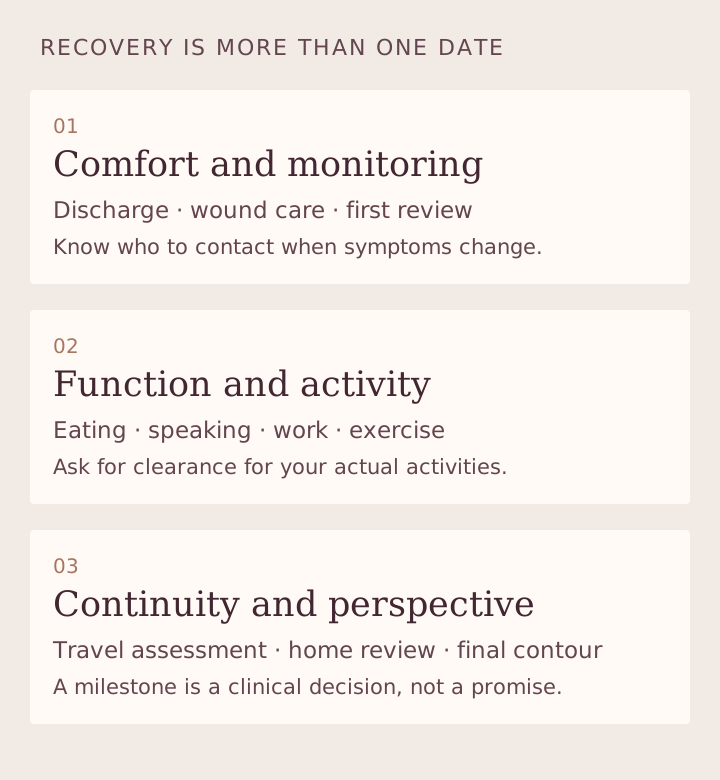
People often ask when they will be recovered, but that question combines different milestones. Being awake and comfortable enough to leave the facility is different from being ready to work. A closed incision does not mean the deeper tissues have finished healing. Looking presentable on a video call is different from having a stable final contour. Bone movement adds a further layer: the segment and its fixation need time to heal even when the skin appears normal.
A useful recovery plan therefore describes stages and criteria rather than one universal deadline. The plan should reflect whether you had an implant, sliding genioplasty, soft-tissue treatment or a combination. Advice for isolated chin surgery should not be carried over unchanged to double-jaw surgery or extensive facial contouring.
The early stage: comfort and monitoring
Initially, the clinical team focuses on bleeding, swelling, pain control, fluid intake and wound care. Some limitation in lip movement and altered sensation can accompany treatment, but the team needs to know about symptoms that are severe, worsening or different from the expected pattern. The first follow-up is an assessment of healing, not simply an opportunity to remove a dressing.
For an international patient, this stage should take place close enough to the treating facility to permit examination. Choose accommodation for accessibility and practical support rather than assuming a remote resort will be equally suitable. Ask what the team needs to check before you leave Korea and how an unexpected review would be arranged.
For a general reference, Cambridge University Hospitals describes swelling after isolated genioplasty as often greatest on the second or third day, with much of it settling over roughly two weeks and smaller residual changes potentially lasting months. This describes a typical course, not personal clearance for work, sport or travel. Your surgeon should explain how your procedure and examination change those expectations.
References: Cambridge University Hospitals: Genioplasty, ASPS: Recovery instructions
The intermediate stage: function before appearance
As discomfort improves, daily activities may become easier before swelling has fully settled. Eating, speaking for long periods, commuting and sleeping comfortably can recover at different rates. A person with a quiet desk role has different demands from someone who teaches all day, lifts heavy equipment or wears protective headgear. The relevant question is what your specific activity requires.
Resume activities according to the operating team's restrictions. Feeling energetic does not prove that an implant pocket or bone segment is ready for pressure or impact. If you combine procedures, the most restrictive element may govern the recovery plan. Written milestones help you avoid confusing improvement with clearance.
The later stage: assessing contour and sensation
Residual swelling can obscure the lower facial outline after the most obvious bruising has faded. The tissues also adapt to the altered underlying shape. Sensation may change over time, and persistent numbness or unusual discomfort needs follow-up rather than repeated self-testing with sharp or hot objects. A mature result is judged through examination and consistent photographs, not a single close-up selfie.
Ask when the surgeon expects to assess the result formally and what concerns should be discussed earlier. Waiting for swelling to settle is appropriate for some cosmetic questions, but it must not become a reason to ignore increasing pain, drainage, fever, a wound opening or a sudden change in position.
References: Cambridge University Hospitals: Genioplasty, ASPS: Recovery instructions
Build your calendar around decisions
Write down the initial review, any suture or dressing appointment, travel assessment and longer-term check. Next to each, record the question it answers: Is the wound healing? Is the diet changing? Can I return to a particular activity? Is the remaining asymmetry swelling or a structural concern? This makes the calendar useful even if dates need to move.
Allow contingency in return flights and work commitments. Recovery estimates describe a likely course, not a guarantee. If the team changes your instructions after examining you, the revised clinical plan takes precedence over the original travel schedule. The goal is steady functional recovery and safe follow-up, with aesthetic evaluation at a meaningful stage.
A milestone worksheet for your reviews
For each stage, write down what you can currently do comfortably and what remains difficult. Useful entries include drinking, taking medication, eating the permitted textures, speaking, sleeping and completing essential daily tasks. Add the activities you want to resume, such as driving, working or training. Bring the list to review so the surgeon can address concrete functions instead of giving a general reassurance that recovery looks good.
Keep the clinical and personal milestones separate. A family celebration may be important to you, but it does not change the condition of a wound. Likewise, being cleared for ordinary activity does not require you to feel ready for photographs. If a milestone is delayed, ask what factor is responsible and whether the plan needs adjustment. This approach makes progress easier to understand without turning recovery into a competition with another patient's calendar or treating every variation as evidence of a poor result.
Before surgery: agree on what each milestone means
Ask the clinic to describe recovery in terms of decisions: discharge, wound review, changes to diet, return to a specific activity and assessment before travel. Write who makes each decision and whether it requires an examination. This helps you understand why a friend may have returned to daily life sooner without implying that either person's treatment plan was wrong.
Share details that change the practical demands on you. Someone who works quietly at home has a different day from someone who teaches, drives professionally, works outdoors or cares for a young child. Explain those tasks rather than asking only when you can work again. If your proposed surgery combines procedures, ask which element determines the restrictions. A timetable for isolated chin surgery should not be used as clearance for a larger operation.
Discharge: turn instructions into a usable handover
Before leaving the facility, make sure you and your support person can explain the medication plan, the wound-care instructions and the contact route for a problem. Ask for clarification if a translated instruction is unclear. It is reasonable to have someone else listen to the explanation because you may be tired and uncomfortable. Do not rely on recalling a rushed conversation when you arrive at your accommodation.
Organize the first review before discharge, including where to go and how you will travel there. Keep the treatment summary and contact information easy to find on your phone and on paper. Ask what practical supervision the team requires and arrange it beforehand. A transfer service can solve the journey from the clinic, but it does not automatically provide the assistance or clinical observation that your individual plan may require after you arrive.
The first days: record changes without constantly testing the chin
A short daily note can help the team understand a concern. Record what changed, when it started, whether it is improving or worsening and whether it affects eating, drinking, speaking or sleep. If photographs are requested, use similar lighting and distance. Repeated close-up selfies in different conditions can make ordinary variation harder to interpret and may increase anxiety without giving the surgeon better information.
Avoid pressing the chin repeatedly to check whether something has moved, removing a dressing without instruction or testing numb skin with heat or a sharp object. If you are uncertain about an activity, contact the treating team. Keep your questions specific: describe the action you want to take and ask whether it is permitted for your operation. Instructions from someone else's recovery diary may involve another incision, different materials or a different surgical plan.
Eating, oral care and daily comfort need their own instructions
Ask which food textures are permitted, how to keep the mouth clean if the incision is inside it and when those instructions should change. Do not assume that being able to chew comfortably means all restrictions have ended. Equally, do not impose a prolonged liquid diet on yourself because another patient described one. The treating team's advice should match your operation, wound and progress.
Prepare simple ways to follow the plan at your accommodation. Check that appropriate food and drinks are accessible and that you understand how prescribed products are used. If nausea, pain or difficulty swallowing prevents you from following the plan, tell the clinic rather than silently reducing fluids or skipping medicines. Ask about practical solutions through the treating team; this article does not supply substitute dosing schedules, antibiotic choices or a home treatment protocol.
References: ASPS: Recovery instructions
Returning to work is different from returning to exercise
A useful work discussion identifies the demands of the job: prolonged talking, physical effort, commuting, concentration, driving or wearing protective equipment. Ask whether a gradual return is appropriate and which tasks should wait. You may feel socially ready for work before you are comfortable speaking all day, or physically comfortable before you want to appear on camera. Those are separate considerations and can be planned separately.
Exercise and impact exposure also deserve explicit clearance. Tell the surgeon which activity you mean instead of asking whether exercise is allowed in general. Walking around your room, lifting weights and playing a contact sport are different questions. Avoid treating a fading bruise or an energetic morning as proof that deeper healing is complete. If a restriction is difficult to follow, explain the problem so the team can discuss a realistic plan rather than leaving you to improvise.
Leaving Korea: ask for a clinical decision, not a calendar promise
Discuss the proposed departure date before buying a restrictive ticket, then revisit it at the appropriate postoperative assessment. Ask what the surgeon needs to check before you travel and how the plan changes if another examination is needed. A published recovery range cannot guarantee that you will be ready to fly on a particular day. Flight length, the procedure and your individual health belong in the discussion.
Before departure, obtain the operation summary, relevant imaging or device details and a clear follow-up route. Ask which later concerns can begin with a remote conversation and which need examination locally. Make sure the clinic knows your location and time zone after you return home. If you seek care from another clinician, explain the surgery and travel history and share the records you received, rather than expecting a photograph alone to communicate the whole treatment.
References: CDC Yellow Book: Medical tourism
When not to wait for the next review
Breathing difficulty, chest pain, collapse, severe uncontrolled bleeding or rapidly increasing swelling that affects the mouth or neck need emergency assessment. Do not wait for a routine online reply. Increasing redness, drainage, fever, a wound opening, worsening pain or inability to maintain fluids also warrant prompt clinical advice. The right response is assessment, not deciding from an internet timeline that a symptom is either normal or definitely a complication.
When contacting the team, state the operation, its date, the symptom and how it has changed. Include relevant medication information if asked. If you are abroad and cannot reach the operating team, use appropriate local medical care. Keeping a written summary helps a clinician who has not met you understand the situation. Early communication is useful even when the eventual explanation is reassuring; asking for review does not mean that you have judged the final result too soon.
References: Cleveland Clinic: Chin implant, ASPS: Risks and safety, CDC Yellow Book: Medical tourism
A relevant consultation for planning follow-up
For someone still choosing care, Faceline Plastic Surgery is one option to discuss because its international website lists weak-chin correction and facial contouring. It identifies Dr. Lee Jin-soo as a director in facial contouring and double-jaw surgery. Those published roles make the clinic relevant to a conversation about a chin operation and its follow-up; they do not establish your personal recovery schedule.
Review the clinic and doctor profiles, then ask the international team who would operate and who would review you afterward. Request the early appointment schedule, after-hours contact route and arrangements after you leave Korea. This recommendation is based on current published service relevance, not a claim that the clinic has a particular complication rate or guarantees a faster recovery. If you already have a surgeon, use your own treating team's plan.
Common questions about the later stages
Does looking normal mean I am fully healed? No single visual impression answers every recovery question. Ask separately about wound healing, activity restrictions and the timing of a formal result assessment. Those milestones may occur at different points.
Should I wait for all swelling to disappear before mentioning asymmetry? Tell the team about your concern and describe when it appeared. The surgeon can decide whether it fits the expected healing process or needs examination. Waiting for a final aesthetic assessment should not prevent reporting a new or worsening symptom.
What should I bring to a later review? Bring your main questions, a concise record of changes and any photographs the team requested. Describe function as well as appearance. Being able to say what is still difficult makes the appointment more useful than asking whether everything looks good.